
Field service apps
Job sheets, checklists, photos, signatures and parts used, captured on site and synced when a connection returns. Replaces the paper docket and the evening spent typing it up.
Most business apps do not need to be the next consumer product. They need to let twelve engineers record a job on site, without signal, and have it reach the office before they get back to the van. That is the kind of app we build.
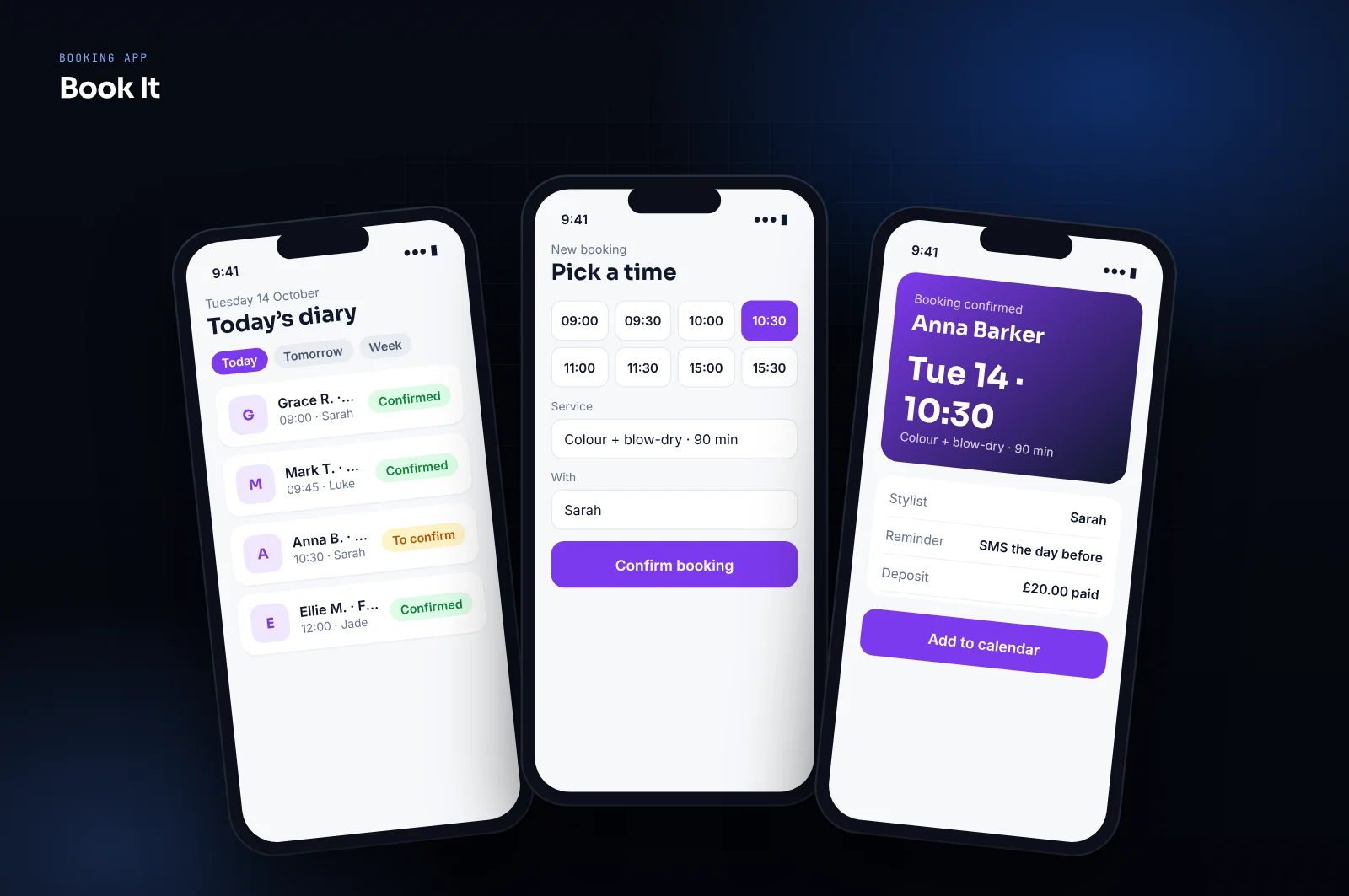
Four categories cover the overwhelming majority of business app work.
Job sheets, checklists, photos, signatures and parts used, captured on site and synced when a connection returns. Replaces the paper docket and the evening spent typing it up.
Catalogue, stock, customer-specific pricing and order capture for reps in the field, connected to the system that already holds the data rather than duplicating it.
Booking, account access, order tracking, loyalty. Worth building when customers use it weekly; rarely worth it when they would use it twice a year — a good mobile website does that job better.
Warehouse scanning, stock counts, time recording, inspections. Small apps with a very short payback, because they remove a manual step performed hundreds of times a week.
The first honest question is whether you need an app. If the thing works in a browser and users open it from a desk, a well-built web application costs less, ships faster and skips app store review entirely. We say this even though it is the smaller project, because an unused app on a store listing is worse than nothing.
When an app is genuinely the right answer — offline capture, camera, barcode scanning, background location, push notifications — the next question is how it is built. For most business apps a cross-platform build covers iOS and Android from one codebase at roughly half the cost of two native builds, with no difference the users will notice.
Native builds still make sense for heavy camera work, complex offline sync or demanding graphics. We will tell you which case you are in during the first call, with the reasoning, rather than defaulting to whichever is more profitable to build.
Clients usually estimate app cost by counting screens. In practice the screens are the cheap part. What drives the budget is offline synchronisation, conflict handling when two people edit the same record, integration with an existing system that was never designed to be integrated with, and the store review process.
So the estimate follows those four things, not the wireframe count. It also means the honest way to reduce cost is to cut sync complexity or integration scope, not to remove screens — which is the first thing most quotes propose.
You always know where the project stands, what it costs and when it goes live.
A web app opens in the browser, needs no installation and works on desktop, tablet and phone. Here too you can start on a monthly fee or take an application that is already built and use it straight away.
€50per month
VAT included · no activation fee
from €750one-off
VAT included · running from day one
A focused first version — one workflow, offline capture, one system integration — typically lands in the mid four to low five figures. Consumer-facing apps with accounts, payments and notifications run higher. We quote per stage after the first call.
A first production version usually takes eight to sixteen weeks, of which app store review is one to two. The prototype stage arrives much earlier, normally in two to three weeks, which is when most of the real decisions get made.
Straightforward cross-border services. For EU clients it is an intra-community invoice with no Italian VAT and reverse charge on your VAT number. For UK clients it is an import of services, handled the same way as any other overseas supplier: your accountant will recognise it immediately.
You do. Source code and documentation sit in your repository under your name, with no licence tied to us. If you want another team to take over in two years, they can — which is precisely why the documentation is part of every handover rather than an extra.
Not with us, but it will need maintenance. iOS and Android both make breaking changes annually, and an app left untouched for two years will eventually stop being accepted by the stores. That is a few hours a year, not a retainer — and any competent developer can do it, because the code is yours.
The work is the same; the cost base is not. As a mobile app development company UK businesses hire, we operate from Northern Italy, one hour ahead of the UK, which keeps the reply time within the working day. Compared with a mobile app development company London, the difference shows up in the rate rather than in the process, and compared with an offshore team it shows up in how fast questions get answered.