
Search campaigns
The words your customers type when they already have a problem to solve. These are the campaigns that produce quote requests, because they reach people buying now rather than browsing.
A Google Ads campaign is the fastest way to appear at the top when someone searches for exactly what you sell. It is also the fastest way to burn a budget when nobody is watching the right numbers. We work in cost per enquiry, not impressions.
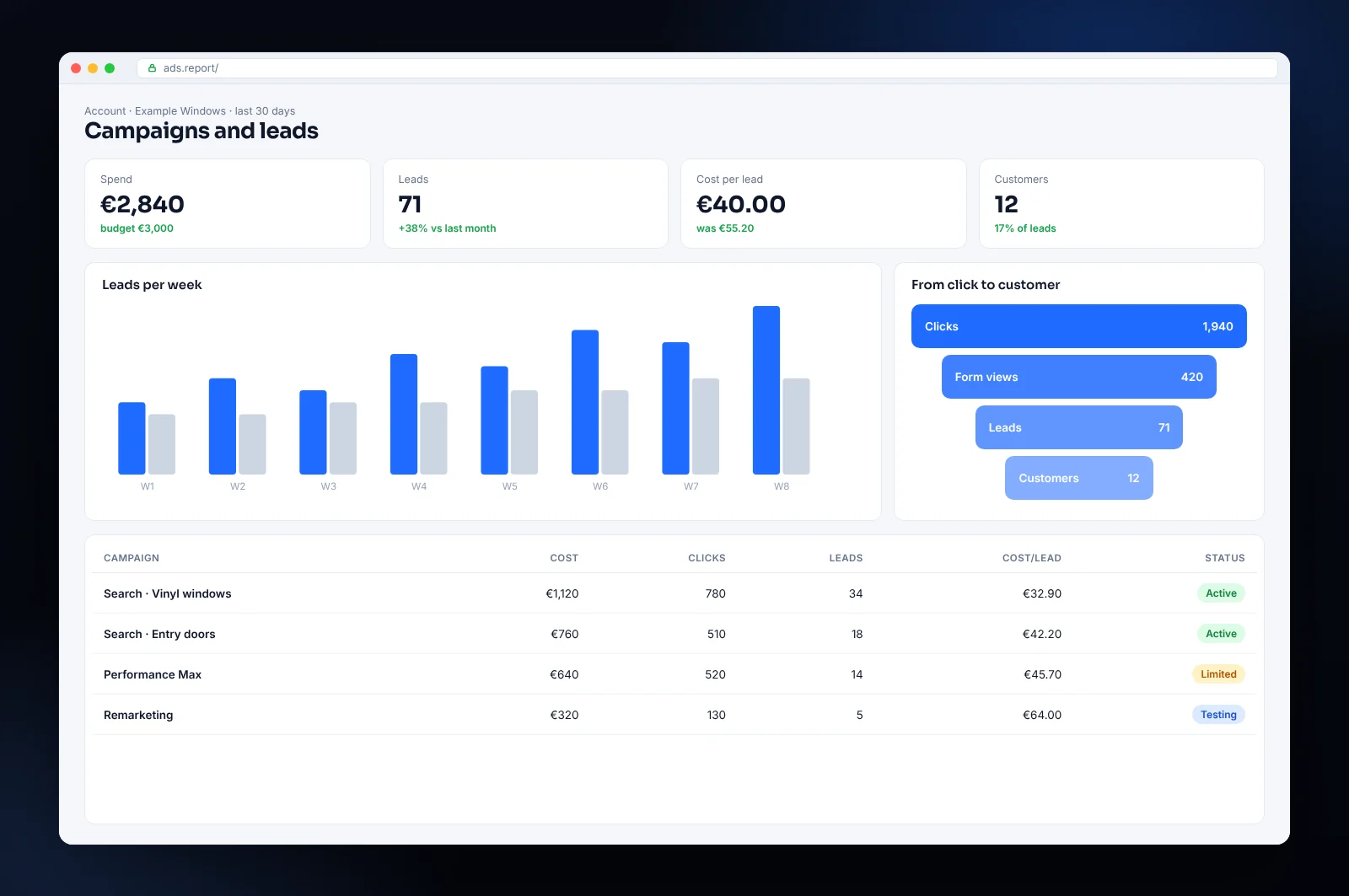
Four campaign types cover almost everything that comes in.
The words your customers type when they already have a problem to solve. These are the campaigns that produce quote requests, because they reach people buying now rather than browsing.
Google spreads the same budget across Search, Maps, YouTube, Gmail and Display. It works well when tracking is clean and badly when it is not, which is why we only switch it on after conversions are fixed.
People who visited the site and did not get in touch. It costs little and recovers a share of the enquiries you would otherwise lose, particularly where the buying cycle runs for months.
Campaigns tied to the Google Business Profile, for companies selling in one region rather than a whole country. Radius, opening hours, call straight from the ad.
Most accounts we inherit share the same fault: conversions are not tracked, or they are tracked wrongly. Contact-page views get counted instead of submitted forms, phone calls appear nowhere, and the form runs through a plugin that reports nothing back to Google. The algorithm then optimises towards the wrong goal, and you pay for traffic that never enquires.
So the first job is always the same. Form, call, WhatsApp, booking — every action worth an enquiry is recorded with a value attached. From then on the question stops being how many clicks and becomes what an enquiry costs, which is the only one worth asking.
After that, optimisation is routine: search terms that spend without converting get excluded, budget moves to where enquiries are cheap, and ads with a weak click-through rate get rewritten. Every month, not occasionally.
UK and Irish companies pay some of the highest agency retainers in Europe, and Google Ads is where that shows most clearly, because the retainer sits on top of media spend that is already expensive. Running the same work from Northern Italy changes the cost base without changing the time zone, the legal framework or the language of the weekly call.
We write ads in English, German, French, Spanish and Italian, which matters if you sell into more than one European market. Running five one-language campaigns through five local agencies is how budgets fragment and reporting stops being comparable.
Invoicing is straightforward intra-EU: an invoice with no Italian VAT, reverse charge on your VAT number. For UK clients it is a standard import of services.
You always know what you are spending, on which terms, and what an enquiry costs.
It depends on the sector, but below roughly £500 a month in media spend there is too little data for optimisation to work, and decisions end up being made on instinct. For most B2B companies the useful starting point is between £700 and £2,000 a month.
A flat monthly fee agreed in advance, not a percentage of ad spend. A percentage creates an obvious conflict of interest: whoever charges it earns more when you spend more, whether or not the spend is needed.
First enquiries arrive within days. Reliable numbers take three to four weeks, the time the algorithm needs to gather enough conversions. Anyone promising stable results in a week is describing luck rather than a method.
Mansuè, in Northern Italy, an hour from Venice. We work in English, run client calls by video and travel for the meetings that justify it.
Yes, and it is usually the cheaper route. The history in a live account is worth real money: it shows which searches have produced enquiries before, so nothing has to start from zero.