
Customers and sales
Records, contact history, quotes, orders and invoices linked together. Who called that customer six months ago and what they were told stops being a mystery.
Almost every company we meet has the same problem: the data exists, but it is spread across three spreadsheets, two notebooks, one person’s memory and somebody else’s inbox. Information is not missing. The place where it all sits together is.
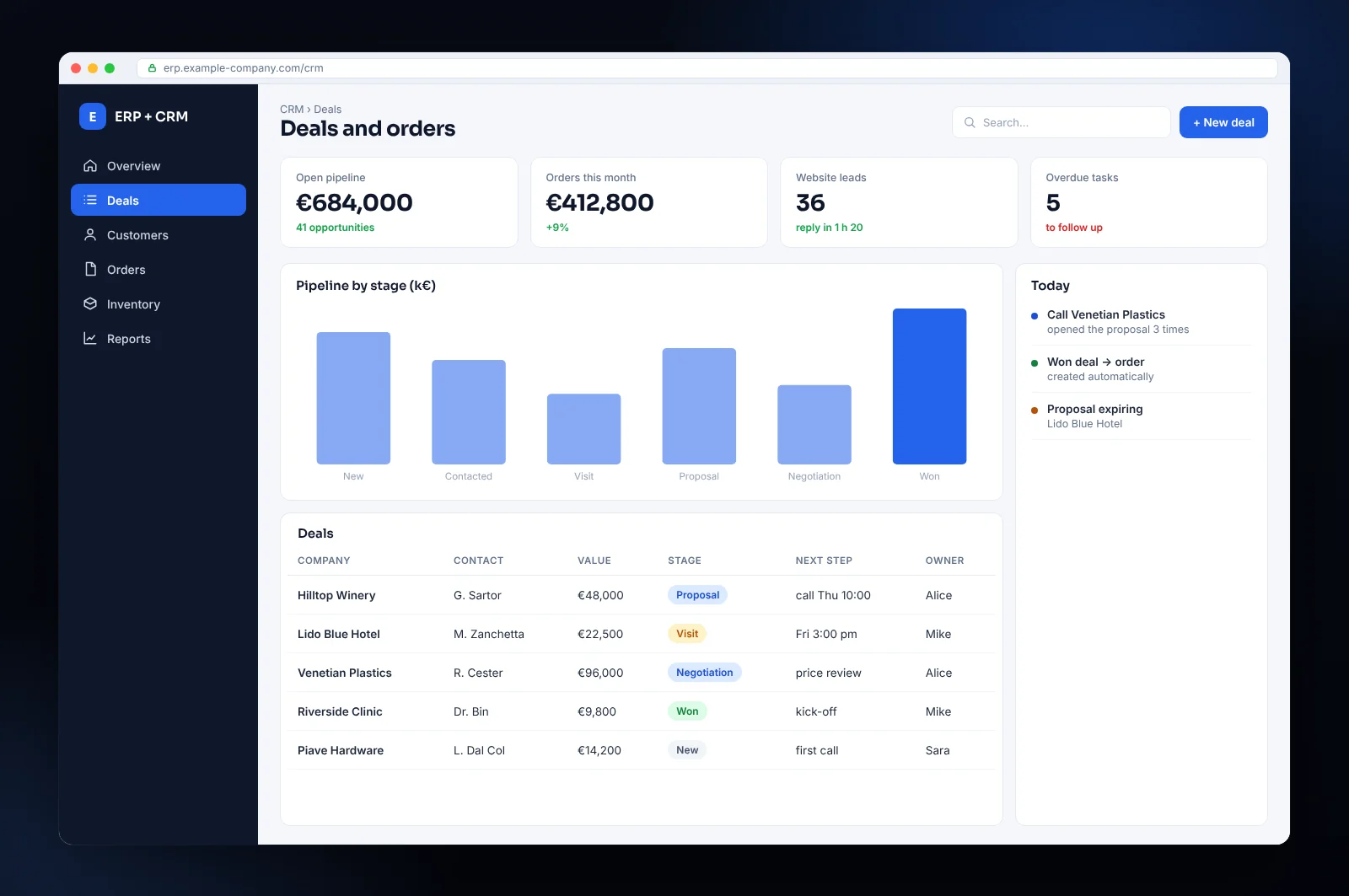
A custom system does not try to do everything. It covers the areas where you are losing the most time, and leaves the rest out until it is needed.
Records, contact history, quotes, orders and invoices linked together. Who called that customer six months ago and what they were told stops being a mystery.
Live stock levels, deadlines, batches, progress of work in hand. Knowing what is really in the warehouse without going to count it.
Every colleague sees what they need and not what is none of their business. Sales does not touch accounting, the warehouse does not see margins.
The numbers you need to decide, updated in real time rather than reconstructed at month end when it is too late to act.
It is the right question to ask, and the answer is not always "custom" — even though custom is what we sell.
An off-the-shelf system costs less up front and is fine when your company works the way every other company in the sector works. It becomes a problem when you have a process of your own: then you either bend it to the software, losing the advantage you had, or you pay for customisations that cost more than a dedicated project. Custom makes sense when the way you work is part of the value you offer, or when the off-the-shelf package would force you to work worse than you do today.
You always know where we are, what it costs and when it arrives. Every stage has a concrete deliverable you can see and approve before we move on.
A management system is an investment whose return can be estimated before making it, and it is worth doing that sum together on the first call.
The arithmetic is simple: how many hours a week your team spends copying data from one place to another, hunting for a document, redoing a quote that already existed. Multiplied by the hourly cost and by the weeks in a year, it produces a figure that usually surprises people.
The quote is fixed price and modular: you pay for the piece being built, you use it, and you decide calmly whether and when to add the next one. No multi-year commitment signed blind on day one.
There is no honest list price here, because a management system is built around the way you work. What we can say upfront is the starting point and how we get to the number: analysis, fixed-price quote, and it does not move after that.
from €1,500per project
VAT included · figure set after the analysis, then fixed
Almost always yes. First we analyse what is worth keeping: if what you have works for accounting but not for production, adding a module makes more sense than rebuilding everything.
Yes, and it is standard practice. Records, history and price lists get imported, so the system starts full rather than empty. It is one of the first things we do.
As many as you need. Since it is yours there are no per-user licences: if the company grows, the bill does not.
It is expected to happen, which is exactly why we work in modules. Additions are priced one by one at a fixed price, with no open-ended contract inflating by itself.
How many hours a week do you lose to manual steps? One call is enough to estimate it and to see whether a custom system pays for itself.
Request a free quote