
iOS and Android apps
Native or cross-platform applications published on the stores, with push notifications, offline access to data and updates managed over time.
Most off-the-shelf software asks you to change how you work in order to fit it. A custom app does the opposite: it starts from how you already work and removes the friction. If you can describe the process to us, we can build it.
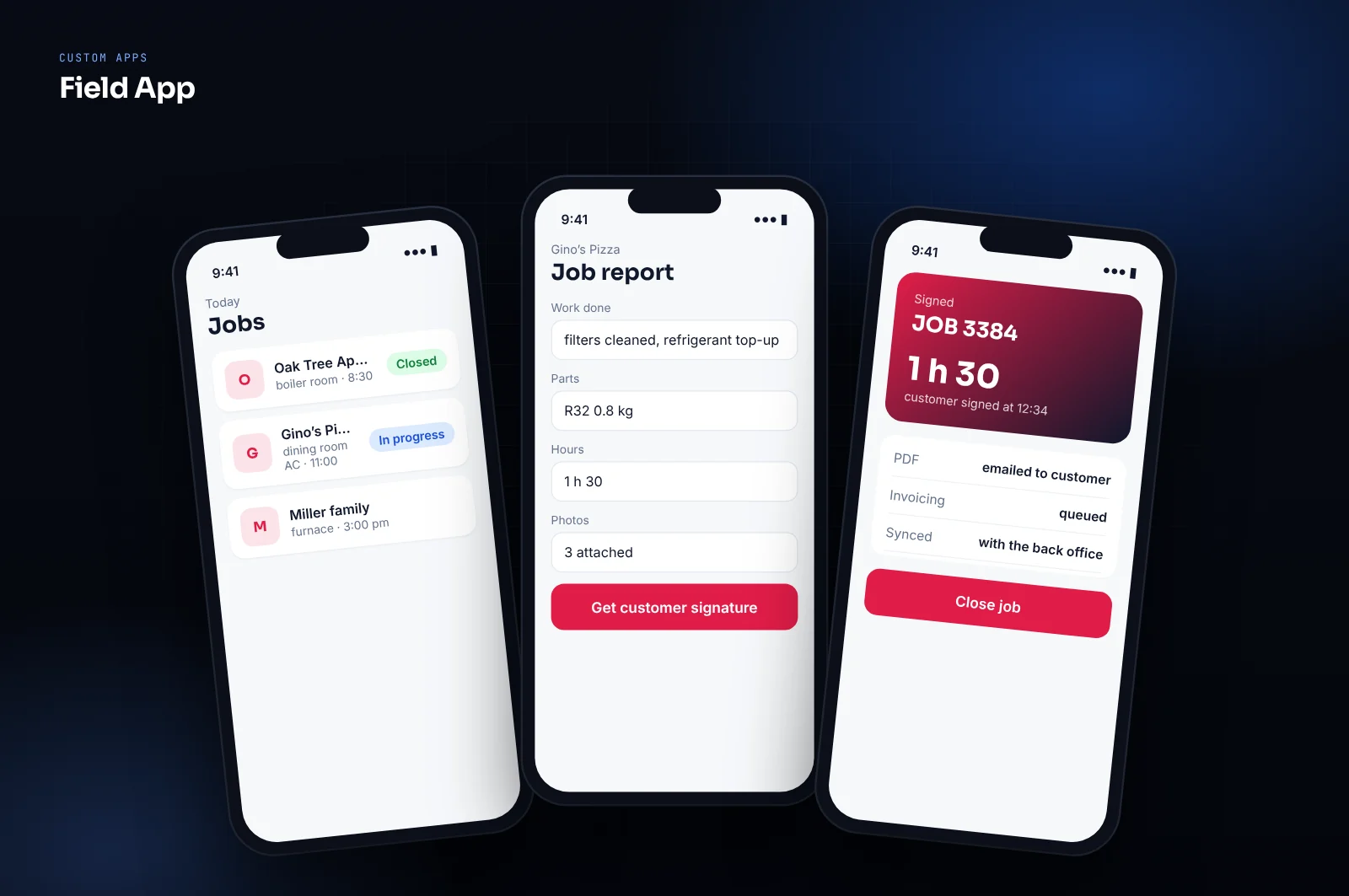
From the prototype that validates an idea to the app that runs the daily work of dozens of people.
Native or cross-platform applications published on the stores, with push notifications, offline access to data and updates managed over time.
Applications that run in the browser, with no installation and no store approval. They update instantly and work on any device.
Logins and roles, notifications, in-app payments, photo and document upload, digital signature, maps. Built when they are needed, not stacked up to pad a list.
The app talks to the management system, the website, the warehouse or the CRM you already use. No separate island forcing you to enter the same data twice.
A custom app is not delivered after six months of silence in the hope it matches what you had in mind. It is built in pieces, and each piece is usable as soon as it is ready.
The advantage is concrete: the first usable version arrives long before the end of the project, and what you learn by using it improves what comes next. Features that looked essential on paper often turn out to be useless once the work is really running, and the other way round.
You always know where we are, what it costs and when it arrives. Every stage has a concrete deliverable you can see and approve before we move on.
An app is measured in months, not weeks: it is the longest kind of project we take on. But the first usable version arrives well before the end.
The quote is fixed price as always, with the scope written down in black and white. Working in modules means that if a new feature emerges along the way we price it separately, rather than letting it disappear into a total that inflates by itself.
Before committing to the whole project you can stop at the prototype: it costs a fraction, shows you the app working across its main screens, and it is yours. It is the least risky way to find out whether the idea stands up.
A web app opens in the browser, needs no installation and works on desktop, tablet and phone. Here too you can start on a monthly fee or take an application that is already built and use it straight away.
€50per month
VAT included · no activation fee
from €750one-off
VAT included · running from day one
Almost entirely on how much it has to do. The most honest way to find out is to start with the prototype: it costs a fraction of the full project and gives you a quote based on something concrete rather than a spoken description.
Very often the second, and we say so even though it is worth less to us. An app makes sense when you need push notifications, offline use, or access to the camera and sensors. If none of those apply, a web app costs less and does not have to go through the stores.
Yes, we handle publication to the App Store and Google Play, listings included. The accounts stay in your name.
Apps need updating, otherwise sooner or later they stop working or get removed from the stores. That is why maintenance is part of the conversation from the start, not a cost you discover in year two.
Tell us about it on a call. If it helps, we start with a prototype: it costs little and shows you whether the idea stands up before you really invest in it.
Request a free quote