
Practice-area pages that rank
One page per matter type and jurisdiction, written to answer what a prospective client is actually asking. The single biggest driver of organic leads for firms.
A law firm website has two jobs: rank for the specific matters you want, and turn a stressed visitor into a consultation. Most fail at both because they are built as brochures. We build them as intake systems — accessible, fast, and measured on signed clients, not page views.
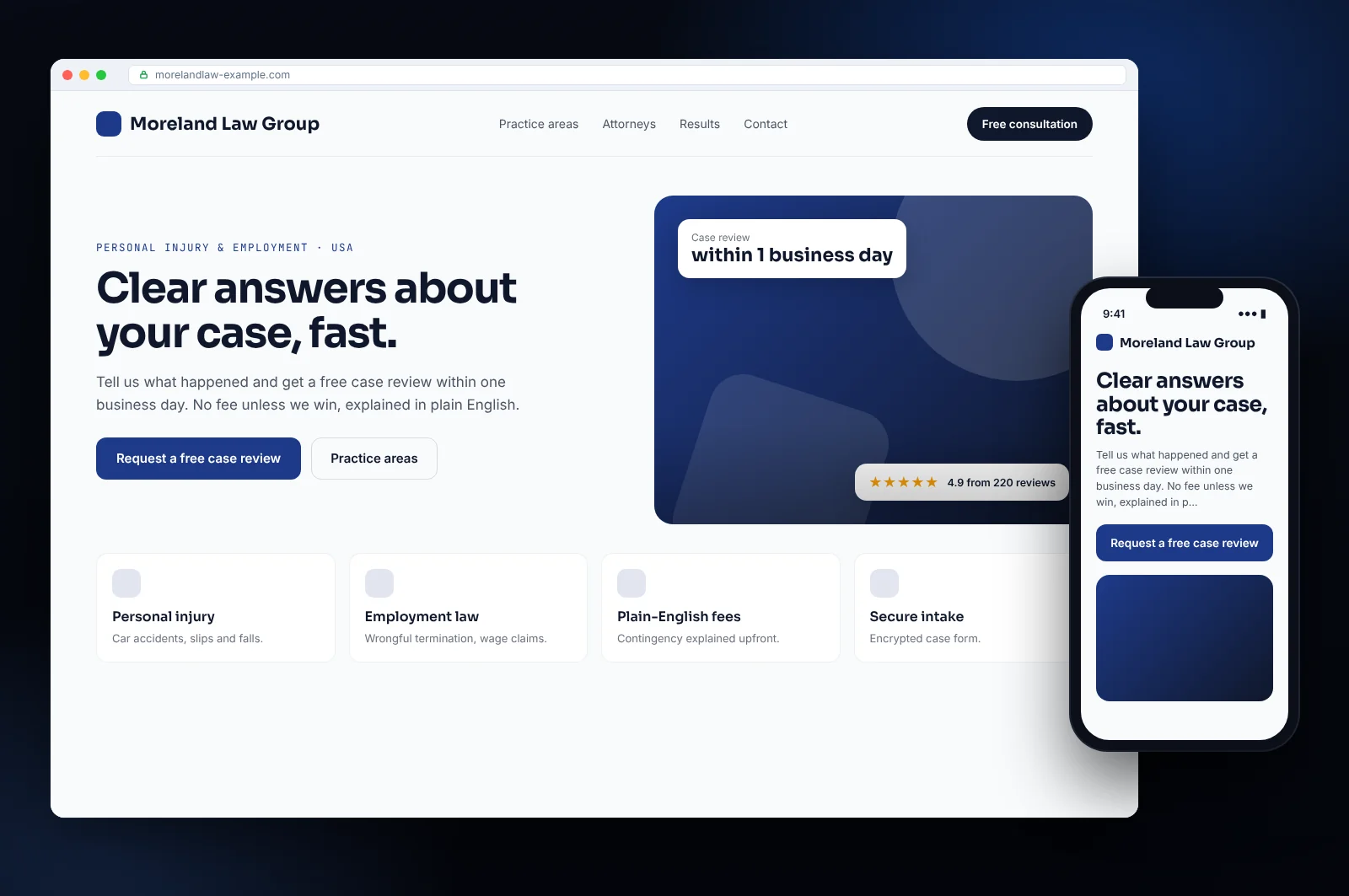
One page per matter type and jurisdiction, written to answer what a prospective client is actually asking. The single biggest driver of organic leads for firms.
Short forms that ask the right qualifying questions and send each lead to the right attorney or paralegal, with conflict-check fields where you need them.
Most legal searches happen on a phone, often in a hurry. Call buttons, call tracking and a chat or text option that someone actually answers.
Documents, case status, invoices and secure messaging, replacing email attachments and "any update?" calls.
Bios that show experience concretely, case results where your state's rules allow, and Google reviews displayed properly.
For firms serving Spanish-speaking clients: a real Spanish site, not a translation widget, that ranks for Spanish searches.
Legal keywords are among the most expensive clicks on Google Ads — personal injury terms in big cities can cost well over a hundred dollars a click. Organic rankings for specific matters are slower to build but cost nothing per click once they hold.
The firms that win organically do it with depth: a real page for each practice area in each place you practice, answering the questions clients ask before they call. Generic "we fight for you" pages do not rank and do not convert.
Your Google Business Profile matters as much as the website for local matters: categories, service areas, photos, and a steady, rules-compliant flow of reviews.
Law firm sites are a frequent target of ADA website claims, which is awkward for a firm. Every site we build follows WCAG 2.1 AA and is tested with keyboard and screen readers before launch.
State bar advertising rules differ — on testimonials, case results, specialization claims and disclaimers. We build the structure and leave the wording decisions to you; we will flag anything that commonly needs a disclaimer.
Forms do not create an attorney-client relationship unless you say so, and the site should say that clearly. Portals use encryption, access control and logging, and hosting sits under your firm's account.
We work remotely with law firms across the country, with calls in your morning and the build happening while you are offline. Local market notes, city by city:
Northeast: New York · Boston · Philadelphia · Washington, DC
Southeast: Miami · Atlanta · Orlando · Tampa · Charlotte · Raleigh · Nashville
Midwest: Chicago · Minneapolis · Detroit · Columbus · Kansas City
Texas and the Southwest: Houston · Dallas · Austin · San Antonio · Phoenix · Las Vegas
West Coast and Mountain: Los Angeles · San Francisco · San Jose · San Diego · Seattle · Portland · Denver · Salt Lake City
A focused firm site starts from €350 one-off; most firms need more practice-area pages, intake routing and integrations, and get a fixed quote after a free call. Client portals are quoted per stage.
Where the software offers an API — Clio and MyCase do — we can send intake leads straight into it, so nobody retypes them.
We draft practice-area pages from an interview with your attorneys, who correct and approve them. That is the only way legal content ends up both accurate and readable.
A company website costs €350 one-off, plus €150 if you want the initial optimization for Google and Bing, or €24.80 a month with hosting, domain, maintenance and content changes included on a 24-month minimum term. Web apps start at €50 a month or €750 one-off; custom business software starts at €1,500. Larger projects get a fixed quote after a free analysis.
Yes. On the one-off option the domain, hosting, content and source code are registered in your company's name from go-live, and the code lives in your repository. There is no license tied to us and no lock-in.
Our invoices to US businesses are issued without Italian VAT, because business services sold outside the EU are not subject to it, and as a foreign service provider we do not add US sales tax. Your accountant will confirm how to record it on your side — it is a standard cross-border arrangement.
Thirty minutes on a video call, free and with no sales deck: we tell you what you actually need, what it costs and how long it takes to go live. If we are not the right fit, we tell you that too.
Book a free call