
Know your trackers
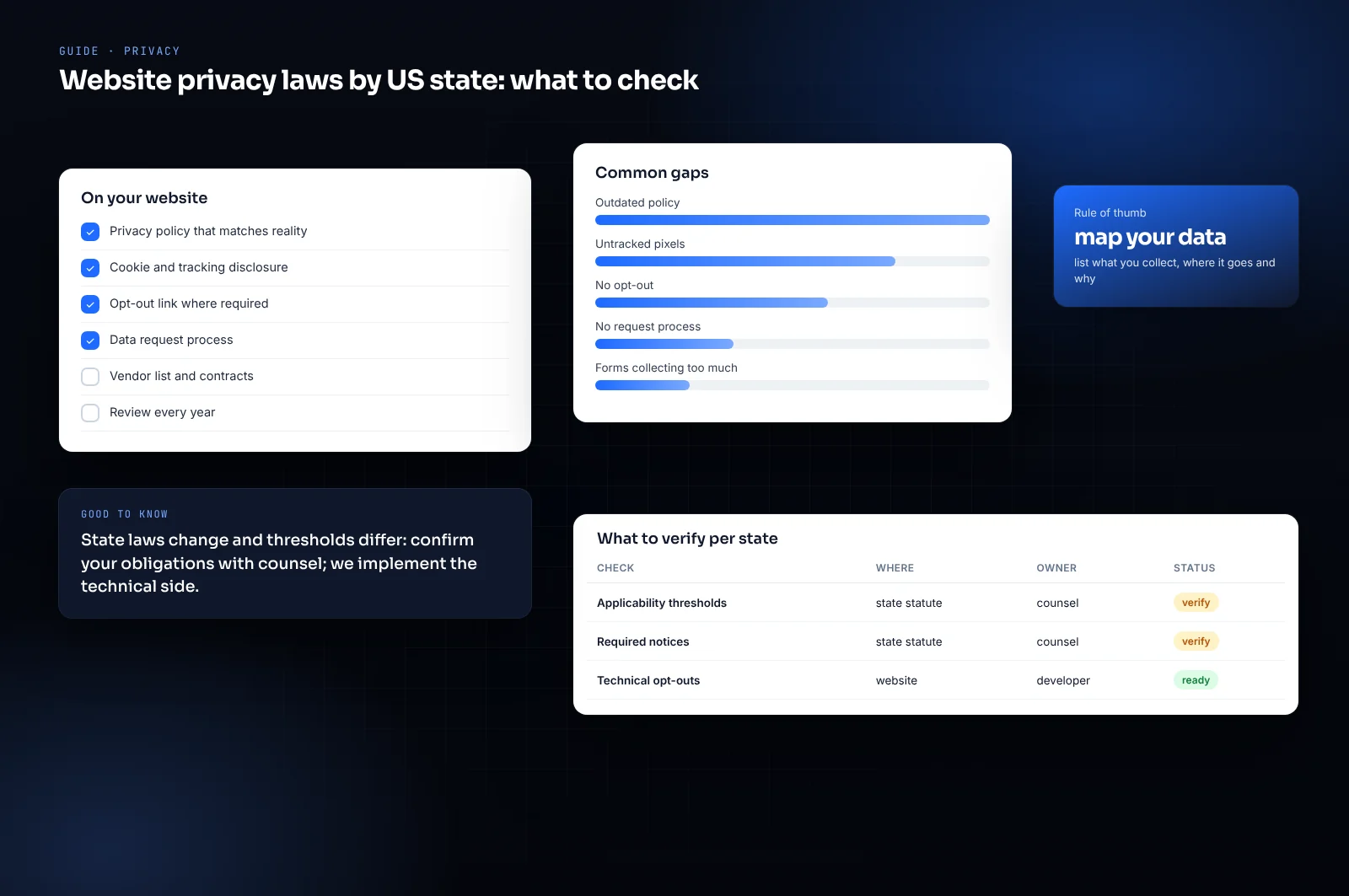
List every pixel, tag and script on the site and what data each sends where. Most sites have more than their owners think.
The US has no single federal privacy law for websites; it has a growing patchwork of state laws. Here is a practical overview of what they mean for your site — consent, opt-outs, forms and health data — written by developers. It is not legal advice: confirm your obligations with counsel.
California led with the CCPA, expanded by the CPRA. Since then, roughly twenty states have passed comprehensive consumer privacy laws, including Virginia, Colorado, Connecticut, Utah, Texas, Oregon, Montana, Iowa, Delaware, New Jersey, New Hampshire, Tennessee, Minnesota, Maryland, Indiana, Kentucky and Rhode Island, with effective dates spread from 2023 into 2026.
Most apply only above thresholds — revenue, or the number of residents whose data you process — but the thresholds differ. California's main revenue threshold is around $25 million, adjusted for inflation; Texas applies to most businesses that are not small businesses, and restricts selling sensitive data even for those that are.
Separately, Washington's My Health My Data Act and a similar Nevada law cover consumer health data with no revenue threshold, reaching many fitness, wellness and even some retail sites.
List every pixel, tag and script on the site and what data each sends where. Most sites have more than their owners think.
A banner that blocks non-essential trackers until consent where required — not one that just displays text.
Where required, a working "Do Not Sell or Share My Personal Information" link and the logic behind it.
California and Colorado, among others, require honoring browser signals like Global Privacy Control.
Collect only what you need, explain why, and keep sensitive data out of ad platforms.
The privacy policy must describe what the site actually does. We make sure the site does what your counsel writes.
Advertising pixels on pages where people book medical appointments or describe health conditions have triggered regulatory warnings and lawsuits. Healthcare providers, wellness businesses and pharmacies should keep tracking off those pages.
HIPAA applies to covered entities and their vendors; state consumer health data laws reach much further. If your site or app touches health, fitness or wellness information, design data collection with counsel from the start.
Children's data is another special case: COPPA applies to sites directed at children under 13 or that knowingly collect their data.
Only if you meet one of its thresholds — roughly $25 million in revenue (inflation-adjusted), or large volumes of California residents' data, or significant revenue from selling or sharing data. Counsel can confirm.
Not everywhere, but laws in several states require consent for some processing and opt-outs for targeted advertising. A properly configured banner is the simplest way to cover them.
A browser signal that tells sites the user opts out of sale or sharing of their data. California and Colorado require businesses covered by their laws to honor it.
We implement the technical side — tracker audit, working consent, opt-out links, GPC support, minimal forms. Your counsel decides the policy and legal obligations.
Thirty minutes on a call: we look at what you need and give you a fixed price in writing, with no obligation.
Book a free call